
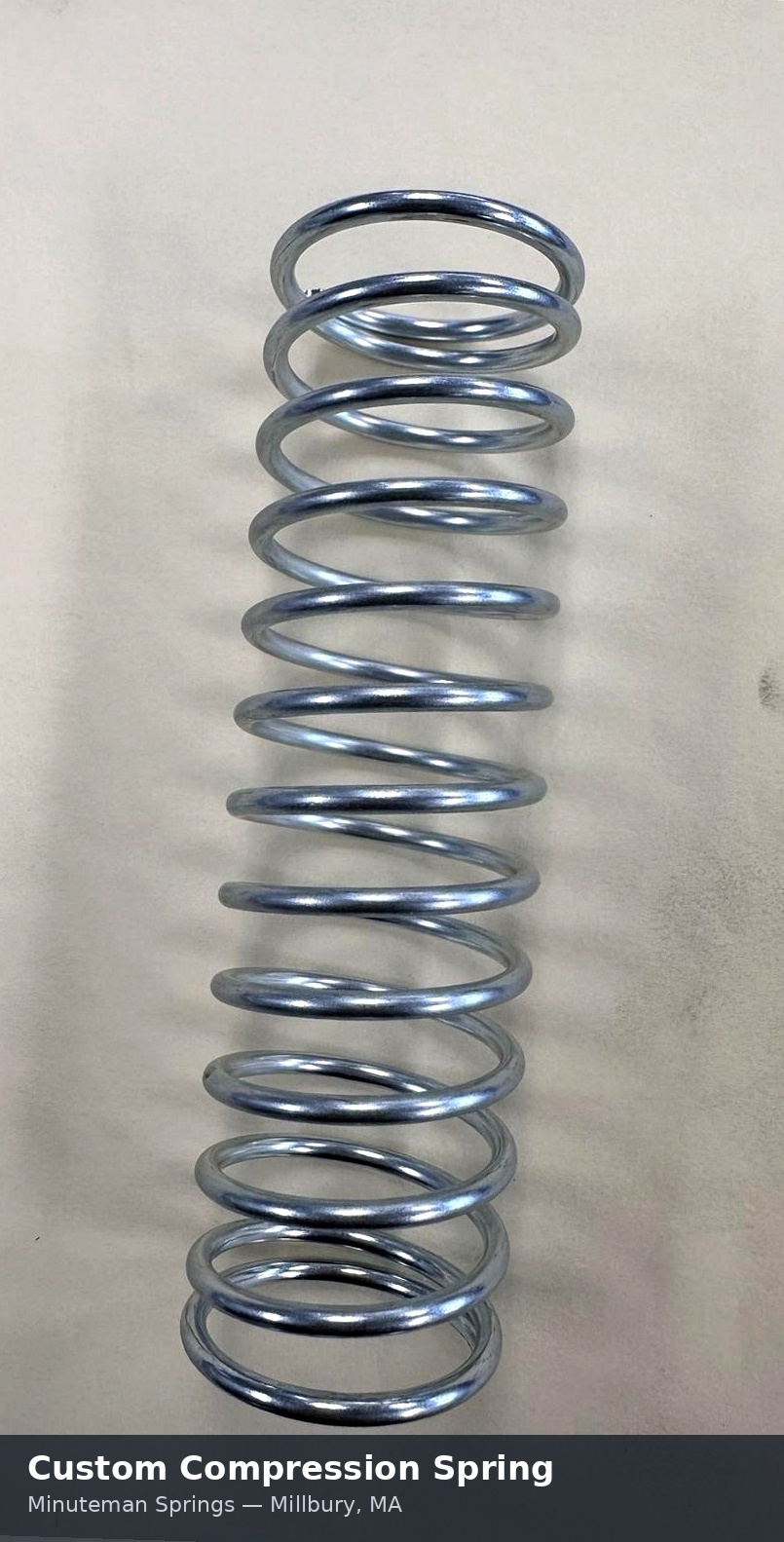
Why Custom Springs Outperform Off-the-Shelf Springs in Industrial Automation
Quick Answer: Custom springs engineered for your specific automation equipment last 5x longer than off-the-shelf springs, reduce unplanned downtime, and lower total cost of ownership by 30-40%.
Why This Matters
Automated manufacturing lines operate at speeds that generic springs can’t handle. Off-the-shelf springs are designed for average conditions — not the high-cycle, high-stress demands of your specific equipment. When a spring fails mid-production, you face equipment downtime, missed shipments, and emergency replacement costs that far exceed the price difference between generic and custom springs.
The problem compounds over time. Each spring replacement disrupts your line, costs labor hours, and risks product quality issues. A custom spring engineered for your exact load, cycle rate, and environment eliminates these failures before they happen.
How Off-the-Shelf Springs Fall Short
Generic springs are manufactured for broad compatibility, which means they’re optimized for no one’s specific needs. They’re typically designed for moderate cycle counts (10,000-50,000 cycles) and average loads. Industrial automation lines run 100,000+ cycles per shift.
When springs are undersized for their duty cycle, they experience accelerated fatigue. The coil geometry isn’t optimized for your exact load curve, so stress concentrations develop early. The material might not resist corrosion in your environment — humidity, coolant exposure, or salt air accelerates degradation. Within weeks or months, the spring loses preload and performance collapses.
The cost of downtime — production halt, labor to replace the spring, potential scrap from the line shutdown — typically runs $500-$2,000 per failure. Most operations experience 3-5 spring failures per year, adding up to $1,500-$10,000 in indirect costs alone.
Custom Spring Engineering for Automation
Custom springs are designed specifically for your equipment and environment. An engineer analyzes your load profile, cycle rate, temperature range, and corrosion exposure to spec a spring that will perform for years without fatigue.
The design process starts with your actual operating parameters. If your automation line cycles 200,000 times per shift at a 50-pound load with 30% deflection, the spring is engineered precisely for those conditions — no compromises. The coil geometry, wire diameter, material, and heat treatment are all optimized to handle that duty cycle indefinitely.
Material selection makes a huge difference. A stainless steel spring resists corrosion in high-humidity environments. Hastelloy or Inconel springs handle high-temperature automation. Music wire provides maximum fatigue resistance for ultra-high-cycle applications. Off-the-shelf options rarely include these premium materials.
Real-World Example: Aerospace Component Assembly
One of our clients operates a high-speed assembly line for aerospace components. They were replacing compression springs every 4-6 weeks at a cost of $800 per replacement (parts + downtime). The original springs were generic compression springs handling 150,000 cycles per day in a corrosive coolant environment.
We engineered a custom Hastelloy-C compression spring with optimized load curve and corrosion resistance. The first custom spring lasted 18 months without degradation. Over three years, they reduced spring-related downtime by 95% and eliminated $10,000+ in replacement costs.
Key Performance Metrics to Track
When evaluating a spring’s performance, track cycle count before fatigue, downtime events per year, and total cost of ownership. A quality custom spring shows measurable improvement across all three metrics.
Cycle count tells you if the spring is properly sized for your load. A spring lasting 5x longer proves the engineering worked. Downtime reduction is the business metric — fewer production halts means more output. Cost of ownership includes parts, labor, and indirect costs; custom springs typically pay for themselves within 12 months.
Frequently Asked Questions
Q: How much more expensive is a custom spring? A: A custom spring costs 30-50% more upfront than an off-the-shelf option. However, when you factor in reduced downtime, fewer replacements, and improved productivity, the custom spring pays for itself within 6-12 months. After that, it’s pure savings.
Q: How long does custom spring engineering take? A: Initial design and testing typically takes 2-3 weeks. If you need faster turnaround, we offer same-day quoting on many standard configurations and can expedite to 3-5 business days.
Q: What if my spring needs change as my equipment evolves? A: Custom springs are engineered to spec, so if your cycle rate or load increases, we can re-engineer an improved spring. Most clients find one good design lasts through 5+ years of evolution.
Q: How do I know if I need a custom spring versus off-the-shelf? A: If you’re replacing springs more than once per year, or if a spring failure costs you downtime, a custom spring almost always makes financial sense. Our engineering team can analyze your current costs and show you the ROI.
Q: What materials are available for custom springs? A: We work with stainless steel (corrosion resistance), music wire (fatigue resistance), Hastelloy and Inconel (high temperature), phosphor bronze (electrical conductivity), and specialty alloys for unique environments.
Q: Can you handle rush orders? A: Yes. Minuteman Springs specializes in fast turnaround. We offer same-day quoting and can often ship custom springs within 5-10 business days, depending on complexity.
Ready to Eliminate Spring Failures?
If your automation line experiences frequent spring failures or unplanned downtime, custom engineering is your solution. Our team has 75+ years of experience optimizing springs for high-performance manufacturing environments.
Contact us today for a free engineering consultation. We’ll analyze your current spring application, show you the cost of ownership comparison, and provide a same-day quote for a custom solution engineered to eliminate downtime and extend service life.
- Explore our compression springs designs and extension springs applications.
- Learn more about custom spring design capabilities
- Explore related: How Spring Materials Affect Performance
- See our torsion springs and barrel springs for other spring types.
Ready to Find Your Spring Solution?
Contact Minuteman Springs for same-day quoting on custom compression springs, extension springs, torsion springs, and more.
Minuteman Spring Co., Inc.
Ready to discuss your spring requirements?
Same-day quoting, full engineering support, and precision manufacturing from prototype through production. Founded in 1946. Millbury, Massachusetts.
Request a Quote