
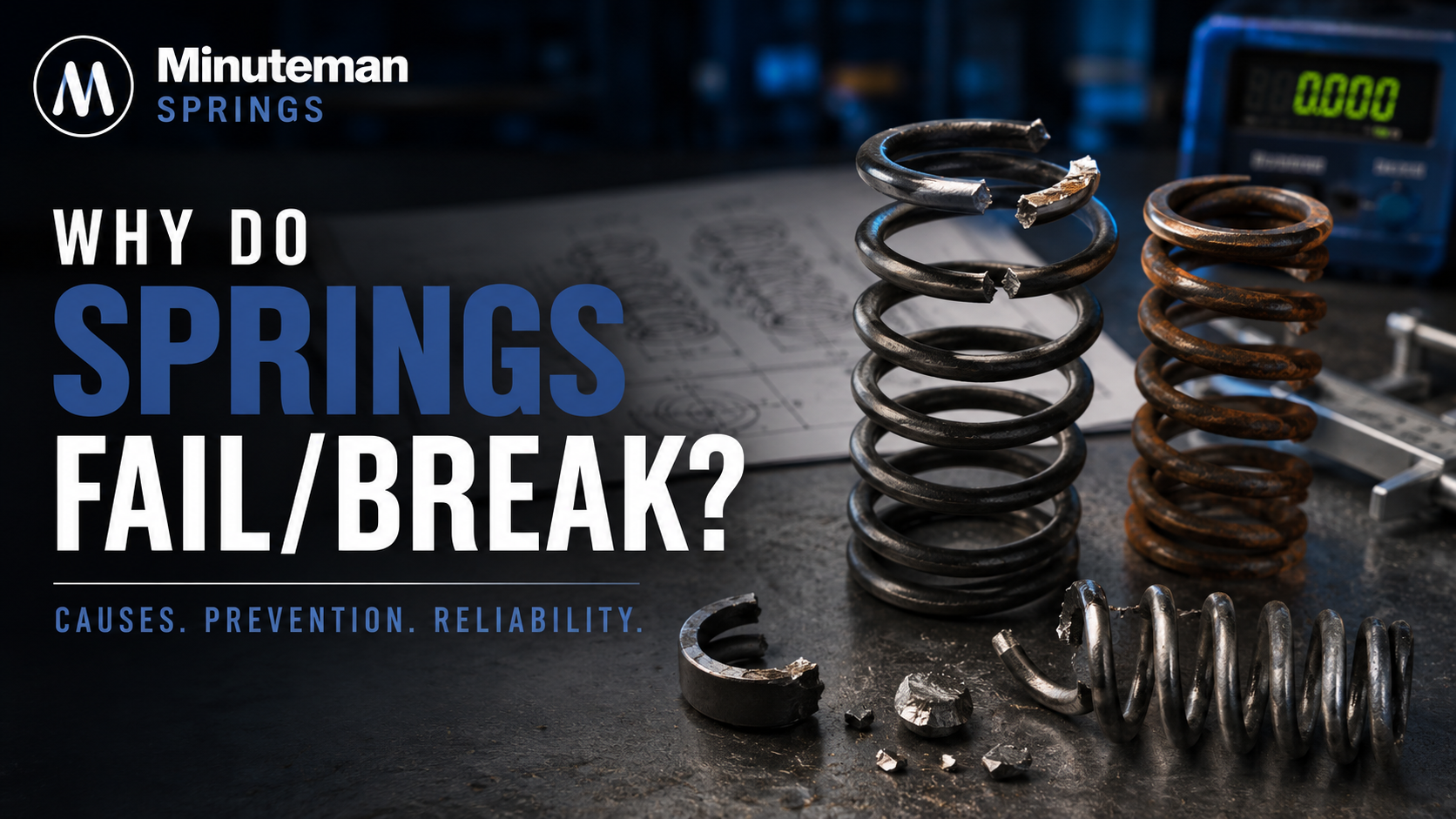
Why Do Springs Fail? 7 Common Causes of Spring Breakage and How to Prevent It
Quick Answer: Springs fail due to fatigue (70% of failures), overloading, corrosion, misalignment, poor design, material defects, or manufacturing flaws. Most failures are preventable with proper sizing, material selection, maintenance, and installation.
Why This Matters
Spring failures are expensive. When a spring breaks unexpectedly, you don’t just replace a $50 part. You pay for emergency labor, expedited shipping, equipment downtime, lost production, and potential damage to connected components. Manufacturing downtime alone costs $260,000 per hour on average—and in automotive, over $2.3 million per hour.
The good news: most spring failures are predictable. Understanding what causes them helps you catch problems early or prevent them entirely.
The #1 Cause: Fatigue Failure (70% of All Spring Failures)
Fatigue is responsible for the majority of spring failures across all industries. Springs are designed to handle repeated cycles of compression, extension, or twisting. Over time, microscopic cracks form at stress concentration points—usually where stress is highest.
Even if peak stress stays below the material’s ultimate tensile strength, repeated cycling eventually causes failure. It’s mechanical damage you can’t see until it’s too late.
Warning signs of fatigue:
- Spring loses force gradually over time
- Reduced load capacity
- Small visible cracks or surface discoloration
- Failure after a predictable number of cycles
Prevention: Ensure your spring design operates well within acceptable stress limits. High-cycle springs engineered to reduce stress per rotation can extend service life significantly. For garage doors, this means upgrading from 10,000-cycle springs to 20,000+ cycle alternatives if your door sees heavy daily use.
Overloading and Excessive Stress
If a spring carries more load than it was designed for, it will weaken, deform, or break prematurely. Overloading often results from underestimating the application’s true requirements or from application creep over time.
A garage door spring rated for 150 lbs paired with a 180-lb door will fail years before its rated cycle life. An industrial compression spring designed for light assembly work pushed into heavy machinery service will snap under stress.
Common overload scenarios:
- Spring rated for 150 lbs installed in 180-lb garage door
- Extension spring extended beyond its design travel
- Compression spring compressed past its solid height
- Dynamic loading exceeding static design capacity
Prevention: Perform accurate load analysis upfront. Work with a spring manufacturer who asks detailed questions about your application, not just parts specifications. First-article testing and prototyping catch overload problems before production.
⚠️ Getting your spring specifications wrong is a costly mistake. Request a free engineering consultation — our engineers will analyze your load requirements, application environment, and cycle expectations to specify springs engineered not to fail.
Corrosion and Rust
Rust is one of the most common spring problems, especially in humid, salty, or chemical environments. Corrosion pits act as stress concentrators, accelerating crack growth and weakening the metal structure.
A carbon steel spring (music wire) in an outdoor or coastal environment will corrode faster than stainless steel. The rust creates friction between coils as they move, generating heat and accelerating wear.
Environments at high corrosion risk:
- Coastal or marine applications (saltwater exposure)
- Outdoor equipment (garage doors, shade awnings)
- Food processing or chemical plants
- HVAC systems with high humidity
- Industrial facilities with vibration and moisture
Warning signs:
- Visible rust on spring surface
- Discoloration or pitting
- Reduced elasticity or loss of force
- Spring operating noisily (friction between corroded coils)
Prevention: Choose corrosion-resistant materials upfront. 304 or 316 stainless steel resists most corrosion. For severe environments, 17-7 PH stainless or specialty nickel alloys are worth the cost. Apply protective coatings or finishes. Store springs in dry conditions. Regular inspection catches early corrosion before it compromises performance.
Don’t gamble on material selection. If your spring operates outdoors, in saltwater, or in a chemical-rich environment, the wrong material will fail early and cost you far more than choosing right upfront. Get expert guidance on spring materials for your application.
Misalignment and Improper Installation
A spring that tilts in its pocket experiences unintended bending forces. A torsion spring mounted off-center introduces uneven load distribution. A compression spring with high slenderness ratio left unsupported can buckle instead of compress straight.
Misalignment accelerates fatigue failure and uneven stress distribution. Over time, the spring compensates for poor alignment by working harder, shortening its service life.
Common misalignment problems:
- Compression spring tilts or buckets during compression
- End surfaces not perpendicular (off-square)
- Spring not centered in mounting pocket
- Torsion spring mounted off-shaft center
- Spring forced into mounting space that’s too tight
Prevention: Ensure end-squareness meets tolerances (typically within 1° to 2°). For high-slenderness compression springs, use internal guide rods or external sleeves to prevent buckling. Verify proper fit during initial installation. Many springs need design support features (guide pins, mounting pockets) to function correctly.
Poor Spring Design
Incorrect wire size, inadequate coil count, wrong end type, or improper spring constants create overstressed springs that fail prematurely.
An extension spring designed with improper hook position concentrates stress at the hook attachment point—the most common failure location for extension springs. A compression spring specified with a tight index but no ground ends won’t seat properly, creating uneven loading.
Design problems that lead to failure:
- Wire too thin for the load
- Too few coils (spring too stiff)
- End type mismatch for application
- Coil pitch too tight or too loose
- Solid height calculations incorrect
Prevention: Don’t rush the design phase. Work with engineers who understand spring mechanics and your specific application. Perform load analysis before selecting a spring. Use spring calculators to verify force, rate, and travel parameters. Prototype and test before full production.
Spring design isn’t a guessing game. Talk to Minuteman Springs engineers before you order. We’ll design your spring to perform reliably in your exact application, eliminating costly design mistakes and premature failures.
Material Defects and Poor Manufacturing
Non-metallic inclusions (oxides, debris) in the wire, uneven grain structure, or poor surface finish can reduce fatigue life significantly. Tool marks left during manufacturing create stress concentration points where cracks initiate.
Even springs designed perfectly can fail early if the wire quality is subpar or if manufacturing introduces flaws.
Quality issues that cause failure:
- Contaminated or low-grade wire material
- Tool marks on wire surface
- Inconsistent coil pitch or diameter
- Improper heat treatment
- Inadequate stress relief after coiling
Prevention: Specify high-quality wire from trusted suppliers. Partner with manufacturers who have strict material QC and modern equipment. Ask about stress-relief processes and surface treatments. Inspect first articles before ordering full production. Quality springs cost more upfront but avoid costly failures later.
Inadequate Lubrication
Springs need lubrication to reduce friction between moving coils. Without it, metal grinds against itself, generating heat and wear. This is especially critical for garage door springs and other high-cycle applications.
Under-lubricated springs generate excess heat, accelerate corrosion, and fail sooner than their design life predicts.
Prevention: Lubricate springs regularly according to manufacturer recommendations. Use appropriate lubricants for your environment (light oil for indoor springs, rust-inhibiting oils for outdoor). Some applications benefit from protective grease. Check lubrication intervals during preventive maintenance.
Key Takeaways
- Fatigue causes 70% of failures—it’s mechanical wear you can’t see until failure occurs
- Overloading ranks second; accurate load analysis prevents this
- Corrosion risk varies by environment; choose materials and coatings matching your application
- Misalignment and improper installation are completely preventable with careful design and installation
- Material quality and manufacturing precision directly impact spring life and reliability
- Most failures are predictable; preventive maintenance and proper design catch problems early
Preventing Spring Failure: The Real Cost Comparison
Here’s what industrial maintenance data shows:
Reactive (run-to-failure) approach: You wait until the spring breaks. Emergency labor costs 2-3x normal rates. You expedite replacement parts. Production stops—costing $260,000 per hour in downtime. Related equipment gets damaged from the spring failure. Total cost: $15,000–$50,000+ for one spring failure in industrial settings.
Preventive approach: You inspect springs regularly, replace them before failure, and plan downtime. Cost: $500–$2,000 for the spring and scheduled maintenance labor. Downtime: zero (done during planned maintenance windows).
The ROI: Each dollar spent on preventive maintenance saves $5 later. Most preventive programs deliver 200–400% ROI within 12–24 months.
The difference between a $50 spring and a $50,000 failure is a single design decision made upfront. Don’t wait for failure. Get your spring engineered right from the start.
Frequently Asked Questions
Q: How long do springs typically last? A: It depends on cycles and load. Garage door springs rated for 10,000 cycles last roughly 7–10 years with daily use. High-cycle springs (20,000+ cycles) last 15+ years. Industrial springs vary widely by application, but most are designed for 1–10 million cycles.
Q: Can I prevent spring failure with maintenance alone? A: No, but maintenance extends life. Regular inspection, lubrication, and alignment checks catch early problems and remove corrosion risk. However, once a spring reaches its cycle limit, replacement is necessary. Prevention starts with correct design and material selection upfront.
Q: What’s the most common spring failure in residential applications? A: Garage door springs. They fail due to fatigue (hitting cycle limits), corrosion (outdoor exposure and humidity), and overloading (door weight mismatch). Most failures are predictable—tracking cycle count and upgrading to high-cycle springs prevents emergency failures.
Q: Are expensive, high-cycle springs worth it? A: Yes, if your application uses springs frequently. A garage door that opens 8–10 times daily benefits from upgrading to 20,000-cycle springs (instead of 10,000-cycle). The upfront cost premium ($200–$300 more) is recovered in fewer replacement cycles and zero emergency calls.
Q: How do I know if my spring is about to fail? A: Look for warning signs: reduced force output, visible damage or rust, unusual noises (squeaking or creaking), sagging, slower operation than normal, or if the application feels “heavier.” Any of these signals it’s time for inspection and likely replacement.
Q: What happens if a spring fails suddenly? A: Sudden failure can be dangerous. In garage doors, stored energy releases violently—a loud bang comparable to a gunshot. The door becomes a dead weight that opener motors can’t lift. In industrial equipment, cascade failures damage connected components (shafts, bearings, motors) and force production stops. Always stop using equipment immediately if you suspect spring failure.
Ready to Prevent Spring Failures in Your Application?
The difference between a spring that fails after 2 years and one that runs reliably for 10 is often the design decision made before ordering. Getting it right upfront saves money, prevents accidents, and keeps your equipment running.
Let Minuteman Springs Help
Our expert engineers will:
- Analyze your load requirements and application environment
- Specify springs engineered to last—not fail
- Account for temperature, corrosion risk, cycle frequency, and space constraints
- Provide first-article testing to verify performance before production
- Back every spring with quality assurance
How to Get Started
Request a Free Engineering Quote — Tell us about your application, and we’ll design springs that prevent failure, not just replace failure.
Or explore our product pages:
- Compression Springs for load-bearing applications
- Extension Springs for pulling and tension applications
- Custom Springs for unique applications
- Spring Materials Guide for corrosion-resistant options
Don’t wait for failure. Prevent it.
About Minuteman Springs
Minuteman Springs manufactures precision springs for industrial, automotive, HVAC, medical, and residential applications. We specialize in custom spring design and engineering to solve the toughest application challenges—preventing failures before they happen.
Minuteman Spring Co., Inc.
Ready to discuss your spring requirements?
Same-day quoting, full engineering support, and precision manufacturing from prototype through production. Founded in 1946. Millbury, Massachusetts.
Request a Quote